


Beyond Walking: The Bigger Picture of Mobility for Seniors
For many older adults, particularly those in assisted living, walking down a hallway or across a room is a key sign of good mobility. However, it doesn’t tell the whole picture. Crucial daily tasks like rising from a chair, getting into bed, or even just engaging with their community all involve good mobility, too.

That’s why mobility is such an important part of seniors’ well-being. And understanding the full picture can help your team recognize mobility challenges sooner, ensuring residents get connected with the rehabilitation services they need.
What Does Good Mobility Really Mean?
Mobility is the ability to move safely and effectively from one position or place to another. While most people immediately think of walking as an example, good mobility can mean other things for seniors, too, such as:
- Rolling over and repositioning in bed.
- Sitting upright with enough control to complete daily tasks.
- Rising from a chair or toilet.
- Transferring between a bed, chair, wheelchair, or other surface.
- Standing safely while dressing or completing personal care.
- Using a walker, cane, or wheelchair effectively when appropriate.
- Having enough endurance to participate in meals, activities, and social events.
Each ability contributes to how independently a resident can function.
Understanding Mobility Challenges in Older Adults
It’s certainly true that mobility can change with age, but age alone isn’t the only factor to consider. Pain, reduced activity, neurological conditions, and other factors can all affect function.
Reduced activity is a particularly important factor to consider, as even a relatively short period of inactivity (such as after surgery or illness) can contribute to deconditioning. For an older adult with limited reserves, these changes can make everyday tasks more difficult.
It’s also important to remember that declining mobility can show up in subtle ways. A resident may start taking longer to stand from a chair. Someone who regularly attends group activities may begin staying in their room. Another resident may suddenly need more assistance getting dressed or transferring to the bathroom.
Recognizing these changes can help staff identify residents who may benefit from additional support to ensure they get the care they need.
The Building Blocks of Better Movement
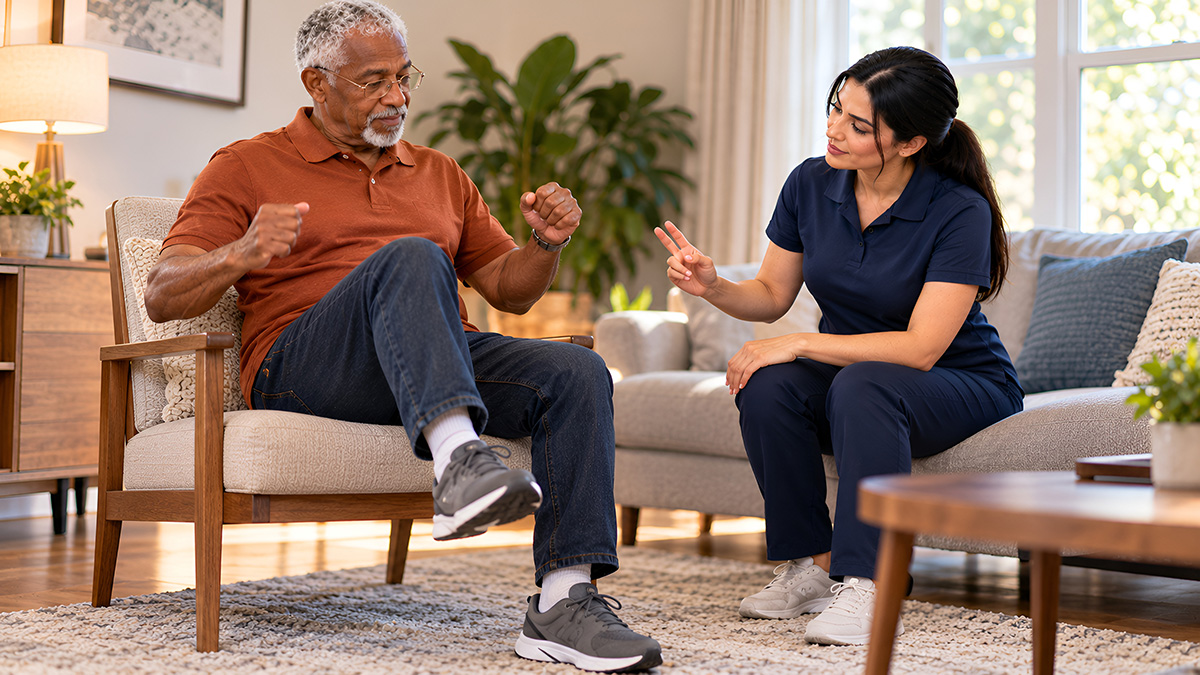
Looking beyond walking also helps the Sobe Rehab team provide truly comprehensive care to improve seniors’ mobility. By blending physical, occupational, and speech therapy as appropriate, we can address the full range of factors that contribute to declining mobility.
Strength Supports Everyday Movement
- Lower-body and trunk strength help residents stand, transfer, maintain balance, and walk. Upper-body strength may also be important for using mobility devices and completing daily tasks.
Balance Supports Safety and Confidence
- Balance involves the coordinated work of the sensory systems, nervous system, and muscles. It’s essential while standing still and while moving, turning, reaching, or changing direction.
Transfers Connect Daily Activities
- A resident may walk reasonably well yet struggle to rise from a low chair or move safely into bed. Transfer ability can have a major effect on independence and caregiver assistance needs.
Endurance Keeps Residents Participating
- Mobility requires enough cardiovascular and muscular endurance to sustain activity. A resident who becomes tired quickly may gradually participate less in their community, even if they can technically walk.
Coordination and Motor Planning Guide Movement
- The brain and body must work together to organize movement. Neurological conditions or other cognitive changes can make sequencing tasks, adjusting movements, or responding to the environment more difficult.
Functional Movement Supports Independence
- Daily tasks like reaching into a closet, getting dressed, or sitting down for a meal all require combinations of strength, balance, coordination, and mobility.
Stronger Mobility Can Support Stronger Communities
Supporting mobility means supporting your residents’ ability to participate in their own lives. Even small changes in balance, endurance, or daily function can have a big impact. Identifying those changes and addressing them with appropriate rehabilitation can play a big role in helping residents maintain greater independence, participate more fully in their communities, and move with greater confidence.
Sobe Rehab partners with assisted living facilities and hospice care centers to provide physical, occupational, and speech therapy services that address the many factors influencing resident mobility limitations, daily functional challenges, and communication or cognitive concerns that affect residents’ independence, participation, and function. Contact us today to learn how our rehabilitation services can support the residents in your community.
Refer a Friend for a Chance to Win a Free Hour Massage
Building Better Mobility Through Balance, Strength, and Coordination
Every time a senior stands from a chair or reaches for their favorite coffee mug, they’re employing a blend of balance, strength, and coordination to accomplish their task. So when even one of these abilities declines, everyday movement can become more difficult.

Fortunately, Sobe Rehab takes a multidisciplinary approach to addressing these key factors, providing physical, occupational, and speech therapy services to support safer, more effective movement.
Three Skills That Keep Residents Moving
Physical therapy builds the foundation for movement.
Our physical therapists can assess balance, muscle strength, walking, transfers, and endurance. Depending on the resident’s needs, care may incorporate progressive strengthening, balance training, walking practice, and functional movements such as standing from a chair.
Occupational therapy turns movement into function.
Balance and coordination are essential for dressing, bathing, toileting, reaching, and other daily activities. Occupational therapy can be practiced in functional settings while introducing adaptive strategies or equipment when appropriate.
Speech therapy can address cognitive skills that affect movement.
Attention, memory, problem-solving, and the ability to follow a sequence of steps can influence how safely a resident completes daily tasks. Speech therapy can address these cognitive skills when they create barriers to function.
Support Better Mobility in Your Community
Changes in balance, strength, or coordination can influence safety, independence, caregiver assistance needs, and participation in community life. It’s essential to work with residents to improve these skills, maintain function, adapt to new challenges, and continue participating in meaningful daily activities.

We Want to Hear Your Success Story!
Click the button below to tell your PT story and leave your review. We look forward to hearing from you!


3 Ways to Practice Gratitude
Did you know that being grateful is actually good for your health? It’s true!
We all love Thanksgiving for the excellent food, football, and time spent with family, but truthfully, this holiday means much more. Practicing gratitude can lead to greater happiness all year long.
“Gratitude helps people feel more positive emotions, relish good experiences, improve their health, deal with adversity, and build strong relationships.”
— Harvard Health PublishingIf you want to implement more gratitude in your own life, take a look at these 3 tips
Write thank you letters
Remember writing thank you letters? How long has it been since you wrote one? You don’t need to have a wedding, graduation, or other big life event to thank the people in your life. Try writing thank you letters to your friends and family for the little things– you’ll be surprised at how good it feels!
Write down what you are grateful for every day
This might sound intimidating, but it doesn’t have to be! Take a few minutes each morning or evening to write down at least 3 things that you are grateful for in your life. This repeated action helps us shift into a more positive mindset and can help fight symptoms of depression and anxiety.
Use visual reminders
It can be hard to remember to practice gratitude. With your hectic schedule, sometimes it can feel impossible to sit down, take a moment to breathe, and reflect on your blessings. Visual cues can be a great tool for reminding us to take a beat.
Something as simple as sticky notes, a poster, or even your home screen on your phone or laptop can help us remember to slow down and shift to a positive mindset.
Make Gratitude a Habit This Season 🍂
A little gratitude can go a long way. Write it down, say it out loud, or leave yourself a reminder — however you practice it, your mind and body will thank you.
Exercise Tip of the Month
Double Knees to Chest
Start on your back with your knees bent. Slowly bring both knees to your chest. Grasp your knees. Hold for 30 seconds and repeat.
Complete 1 set of 3 repetitions, holding each repetition for 30 seconds.
Today’s Exercise Tracker
Check off each repetition as you complete it.

Roasted Brussels Sprouts with Pomegranate
Ingredients
- 1 1/4 pounds Brussels sprouts, trimmed and halved
- 2 tablespoons canola oil
- Kosher salt and freshly ground pepper
- 3 tablespoons pomegranate molasses
- Seeds from 1 pomegranate
- 1/2 cup coarsely chopped toasted hazelnuts
- Finely grated zest of 1 lime
- 1 tablespoon finely grated orange zest
Directions
- Preheat the oven to 375 degrees F.
- Put the Brussels sprouts in a medium roasting pan; toss with the canola oil and season with salt and pepper.
- Roast in the oven until light golden brown and a knife inserted into the centers goes in without any resistance, about 45 minutes.
- Transfer the sprouts to a large bowl and add the pomegranate molasses, pomegranate seeds, hazelnuts, and lime and orange zests.
- Season with salt as needed.
A Colorful Seasonal Side
Sweet-tart pomegranate, crunchy toasted hazelnuts, and fresh citrus bring contrasting flavors and textures to tender roasted Brussels sprouts. It’s a festive addition to Thanksgiving dinner or any fall gathering.
Mission Statement:
Our mission is to deliver a stronger future for seniors in assisted living facilities. The Sobe Rehab 10-step proactive, comprehensive, PT/OT/ST therapy model restores senior independence and quality of life. In ALFs, this translates into improved length of stay and retention, on average 4 years for our patients. This enhances their freedom and happiness while increasing the ALF census exponentially. As the saying goes, “It’s not the days in your life, but the life in your days.”